



8011 Aluminum Foil 90μm For Air Duct | HVAC Barrier
1. Introduction
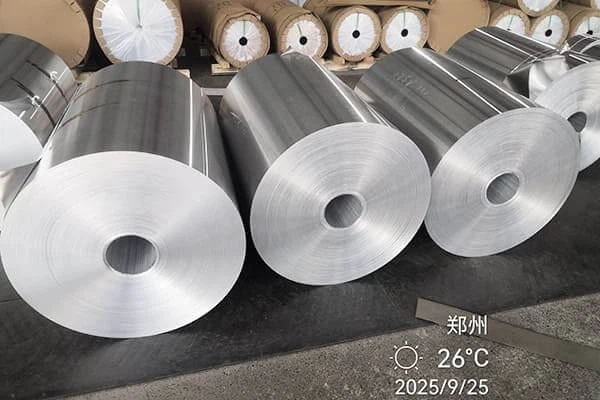
8011 aluminum foil 90MIC for air duct is a high-performance, heavy-duty material specified for the manufacturing of premium flexible air ducts.
This specific grade, often referred to as "heavy gauge" foil, is engineered to provide a significant upgrade in mechanical performance over standard, thinner foils.
The 8011 alloy, an aluminum-iron-silicon composition, offers a baseline of good strength and formability.
The 90μm (0.09mm) thickness dramatically enhances this, delivering superior puncture and tear resistance, improved structural integrity for better shape retention, and a virtually pinhole-free surface for guaranteed air and moisture barrier performance.
Typically supplied in a soft 'O' (annealed) temper for maximum flexibility, this material is the ideal choice for demanding HVAC applications in commercial buildings, industrial ventilation, and cleanroom environments, where long-term durability, system efficiency, and safety are paramount.
2. Chemical Composition and Properties of 8011 Aluminum Foil
2.1 Chemical Composition
The 8011 aluminum alloy belongs to the Al-Fe-Si system, with precise compositional control determining its suitability for HVAC applications.
The alloy specification per ASTM B209 and GB/T 3190 establishes the following elemental ranges
| Element | Composition Range (wt%) | Functional Role in HVAC Applications |
|---|---|---|
| Aluminum (Al) | ≥ 97.0% (Remainder) | Base metal providing structural matrix and corrosion resistance |
| Iron (Fe) | 0.60–1.00% | Grain refinement, tensile strength enhancement (40% contribution to strength), improved puncture resistance |
| Silicon (Si) | 0.50–0.90% | Rolling processability enhancement, eutectic phase formation improving castability |
| Manganese (Mn) | ≤ 0.20% | Solid solution strengthening without significant ductility reduction |
| Copper (Cu) | ≤ 0.10% | Controlled to minimize discoloration and galvanic corrosion potential |
| Magnesium (Mg) | ≤ 0.05% | Trace level for work hardening response |
| Zinc (Zn) | ≤ 0.10% | Corrosion prevention when contacting dissimilar metals |
| Titanium (Ti) | ≤ 0.08% | Grain refinement during solidification |
| Other Impurities | ≤ 0.15% (each), ≤ 0.30% (total) | Ensuring material uniformity and process stability |
2.2 Temper and Mechanical Properties
For air duct applications, 8011 foil is almost always supplied in the 'O' (fully annealed) temper.
The 'O' Temper: This is the softest, most ductile state of the alloy, which is essential for the manufacturing of flexible ducts.
It allows the foil to be easily laminated, corrugated, and helically wound around the steel wire frame without cracking.
| Property (for 8011-O @ 90mic) | Typical Value | Significance for Air Ducts |
| Tensile Strength | ~80 - 110 MPa | Provides the strength needed to withstand the tension of the manufacturing process and the pressures of the HVAC system. |
| Elongation | ≥ 15% | High ductility ensures maximum flexibility of the final duct product. |
2.3 90 µm thickness optimization
Why 90 µm (0.09 mm) is often specified for duct facing:
Mechanical robustness: 90 µm resists tearing during handling, crimping and seaming better than very thin foils (e.g., 6–25 µm).
Vapor and puncture performance: thicker foil is less likely to develop pinholes in fabrication and installation; as an intact barrier it provides near-zero vapor transmission.
Formability balance: at 90 µm the foil still bends and forms easily for elbows, seams and collars without excessive spring-back or cracking when using correct bend radii and tooling.
Economic & weight tradeoff: provides required durability for most HVAC systems without the material and handling cost of foil + thick metal sheet. Typical density ~2.7 g/cm³ → a 90 µm coil weighs ≈ 2.43 kg per m² of single-side foil.
Practical specification tolerances often set thickness ±5% (i.e., 85.5–94.5 µm) unless project conditions call for tighter control.

3. Manufacturing Process of 90μm 8011 Aluminum Foil
3.1 Casting and Rolling
The production of 90μm 8011 foil for HVAC applications initiates with continuous casting of 6–8 mm thick sheet, followed by multi-stage cold reduction :
Process Parameters:
Melting and Refining:
Temperature: 720–750°C with argon degassing
Filtration: Ceramic foam filters (30–50 ppi) removing inclusions >20μm
Hydrogen content: <0.15 ml/100g Al to prevent porosity
Hot Rolling:
Reduction from 6mm to 2.5mm at 350–400°C
Controlled cooling to achieve uniform grain structure (ASTM grain size 5–7)
Cold Rolling Sequence:
Stage 1: 2.5mm → 1.2mm (intermediate anneal at 350°C/4h)
Stage 2: 1.2mm → 0.3mm (intermediate anneal at 340°C/5h)
Stage 3: 0.3mm → 0.09mm (final thickness, H24 temper)
3.2 Thermal treatment and annealing
After cold rolling the material may be:
Fully or partially annealed (O temper) to obtain maximum ductility for deep forming; or
Lightly strain hardened (H-tempers) when additional stiffness is required.
Annealing cycles (temperature and time) control mechanical properties and reduce risks of edge cracking during slitting and forming.
Resulting Mechanical Properties in O Temper:
| Property | Specification | Test Method | HVAC Application Advantage |
|---|---|---|---|
| Tensile Strength | 110–140 MPa | ASTM E8 | Sufficient strength for handling with maximum formability |
| Yield Strength (Rp0.2) | 35–55 MPa | ASTM E8 | Low yield enables complex bending without spring-back |
| Elongation at Break | 25–35% (A50mm) | ASTM E8 | Critical for deep drawing ratios up to 2.5:1 in duct reducers |
| Hardness (Brinell) | 25–35 HB | ASTM E10 | Soft condition prevents cracking during spiral forming |
| Earing Index | <3% | ASTM E517 | Uniform deformation in cup-drawing operations |
3.3 Slitting and edge quality control
Final processing includes precision slitting to required widths, trimming of burrs, and recoiling to specified coil ID/OD.
Edge quality is critical for duct fabricators - rough edges cause tape adherence problems and increase risk of seam leakage.
Good mills inspect edge roughness and provide protective packaging to prevent coil set marks and damage.

4. Key Advantages of 8011 Aluminum Foil 90μm for Air Duct
The specification of 90μm 8011-H24 aluminum foil delivers quantifiable performance benefits across multiple engineering domains:
Mechanical Durability:
The 120–170 MPa tensile strength provides 60% greater resistance to tearing during installation compared to 50μm alternatives, critical when pulling flexible ducts through ceiling cavities with abrasion risks.
Puncture resistance of 40–60N (measured via ASTM D5748 spherical probe) prevents damage from incidental contact with construction fasteners.
Barrier Performance:
With water vapor transmission rate (WVTR) <0.1 g/m²·day and oxygen transmission rate (OTR) <0.01 cm³/m²·day, the 90μm specification maintains insulation dryness even in high-humidity climates (85% RH, 30°C), preserving thermal conductivity of fiberglass insulation at rated 0.035 W/m·K rather than degraded 0.055 W/m·K from moisture absorption.
Thermal Efficiency:
High reflectivity (>85% at infrared wavelengths) reduces radiant heat gain in cooling ducts by 15–20% compared to uninsulated or kraft-faced alternatives, contributing to overall HVAC energy efficiency targets.
The thermal conductivity of 210–220 W/(m·K) facilitates rapid temperature equilibration, preventing thermal lag in variable air volume (VAV) systems.
Corrosion Resistance:
The Al-Fe-Si matrix provides inherent resistance to atmospheric corrosion (weight loss <0.1 mg/cm² in 1,000-hour salt spray testing per ASTM B117), with optional chromate-free conversion coatings or hydrophilic lacquers extending service life in coastal or industrial atmospheres .

Fabrication Compatibility:
The 3–5% elongation characteristic enables spiral forming into flexible ducts with 50–1,000mm diameters without edge cracking, while maintaining sufficient stiffness for self-supporting spans of 1.2–1.5m in rigid ductboard applications.
Economic Optimization:
At 2.71 g/cm³ density, 90μm foil adds only 0.244 kg/m² to duct weight, reducing structural support requirements by 30–40% compared to galvanized steel (7.85 g/cm³) while providing equivalent vapor barrier performance .
5. Applications of 8011 Aluminum Foil 90 Microns in Air Duct Systems
5.1 Commercial Building HVAC Systems
In commercial buildings, where HVAC systems account for 40–60% of total energy consumption, 90μm 8011 foil serves as the exterior vapor barrier in AL-PET-AL laminated flexible ducts.
The specification meets ASHRAE 90.1 energy standard requirements for duct leakage (Class 6, <3 L/s·m² at 250 Pa) through superior seam integrity.
Typical Configuration:
Inner layer: Perforated 90μm 8011-O (for acoustic absorption)
Insulation: 25–50mm fiberglass (R-4.2 to R-8.4 thermal resistance)
Outer barrier: 90μm 8011-H24 with PET lamination (scuff resistance)

5.2 Industrial Ventilation and Dust Removal Systems
Industrial applications demand enhanced durability due to particulate loading and chemical exposure.
90μm 8011 foil with epoxy-phenolic lacquer coating (8–12μm dry film thickness) resists:
Oil mist and hydrocarbon vapors (petrochemical facilities)
Acidic condensate (pH 3–5, metal processing plants)
Abrasive particulates (cement, mineral wool manufacturing)
5.3 Cleanrooms and Medical Environments
ISO 14644-1 Class 5–8 cleanrooms require non-shedding, non-particulating duct materials.
90μm 8011 foil meets these criteria with:
Surface particle generation <0.5 particles/cm² (>0.5μm) per IEST-RP-CC003
Outgassing <1.0% total mass loss (TML) per ASTM E595
Biostatic surface properties (optional silver-ion antimicrobial coating)
5.4 High-End Residences and Villas
For luxury residential applications, 90μm 8011 foil provides acoustic damping (insertion loss 15–20 dB at 1,000 Hz) and thermal insulation in climate-controlled wine cellars, home theaters, and master suites.
The material's compatibility with low-VOC adhesives supports LEED and WELL Building Standard certifications.
6. Huawei Quality Assurance and Testing Protocols
Henan Huawei Aluminum Co., Ltd (Huawei) provides 8011 foil with a structured QA program tailored for HVAC foil products. Typical protocols:
6.1 Dimensional verification
Thickness mapping: Eddy-current or contact micrometer mapping across coil to ensure nominal 90 µm ± stated tolerance.
Width and flatness: Laser or mechanical gauges; coil ID/OD and weight verification.
6.2 Mechanical property validation
Tensile tests on representative coupons (longitudinal/transverse) to verify Rm / Rp0.2 and elongation.
Bend / formability trials to validate minimum bend radius for supplied temper.
6.3 Barrier performance certification
Surface continuity / pinhole detection (visual inspection under magnification or vacuum box tests) to ensure vapor tightness.
Permeance checks or water-vapor transmission tests on laminated assemblies when required by project specs.
6.4 Surface quality standards
Visual defect levels specified (accept/reject criteria for scratches, dents, specks).
Adhesion & coating tests for lacquered or laminated foils (cross-cut, peel strength).
Supply documentation: Mill Test Certificate (MTC) with heat/coil traceability, coating data sheets and sample coils for approval.
7. Comparative Material Analysis
Below is a practical comparison of 8011-90µm with other common foil choices for duct facings (representative guidance):
| Criterion | 8011 90 µm | 1235 / 1100 (pure Al) 90 µm | 8079 / 8011 alternatives | Foil + PET/Kraft laminate |
|---|---|---|---|---|
| Formability | Very good | Excellent (softer) | Very good | Reduced (laminate stiffens) |
| Strength / tear resistance | Good | Lower | Similar | Improved mechanical protection |
| Vapor barrier | Excellent (intact) | Excellent | Excellent | Excellent + puncture protection |
| Tape adhesion | Good (lacquer improves) | Good | Good | Excellent (adhesive bond surface) |
| Cost | Medium (industry standard) | Slightly higher/lower depending on purity | Comparable | Higher (laminate cost) |
| Best use | HVAC facing requiring strength | Lightweight decorative / reflectors | Thin foil packaging / some HVAC | HVAC with higher mechanical abuse risk |
8. Conclusion
8011 aluminum foil 90mic for air duct systems represents a well-balanced solution that aligns performance, durability, and cost-efficiency with modern HVAC requirements.
By combining the inherent corrosion resistance of aluminum with the optimized strength and formability of the 8011 alloy at a 90 μm thickness, this material effectively fulfills the dual roles of vapor barrier and protective facing in air duct applications.
Ultimately, selecting 8011 aluminum foil 90mic for air duct applications enables designers, contractors, and facility owners to achieve reliable airflow containment, effective thermal insulation performance, and durable system operation, supporting both energy efficiency goals and long-term building performance.
FAQs
1. Is 90mic aluminum foil still considered "flexible"?
Yes. Even at 0.09mm, the 8011 alloy in its 'O' temper is extremely soft and ductile. It can be easily bent and formed into the helical shape of a flexible duct.
While it is slightly stiffer than a 20mic foil, its flexibility is more than adequate for its intended purpose.
2. Does the 90mic foil make the duct quieter?
Indirectly, yes. The greater rigidity of the 90mic foil helps the duct maintain its round profile even in tight bends, which promotes smoother airflow (less turbulence).
This can contribute to a reduction in air noise (whooshing sounds) compared to a thinner duct that might collapse or kink.
3. Is this foil used for both the inner and outer layers of an insulated duct?
Yes. It is an ideal choice for both. As the inner core, it provides a durable, airtight channel for the air.
As the outer jacket (vapor barrier) over the insulation, its high puncture resistance is a major advantage, protecting the delicate insulation layer from damage during installation.
Send Inquiry
