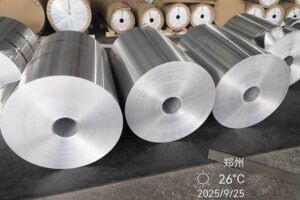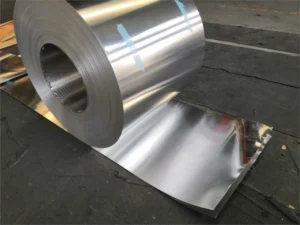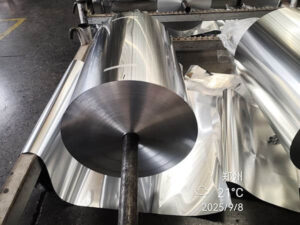
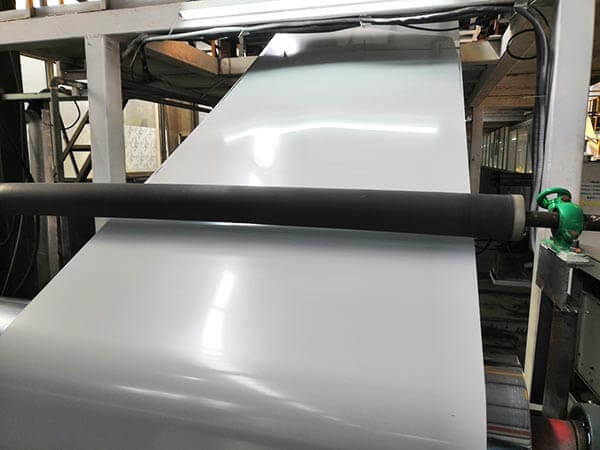
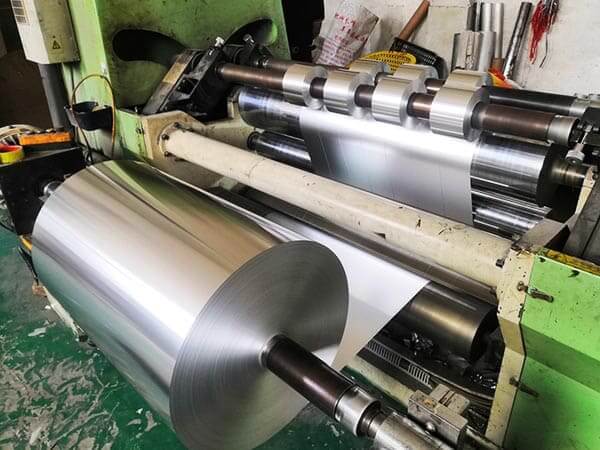
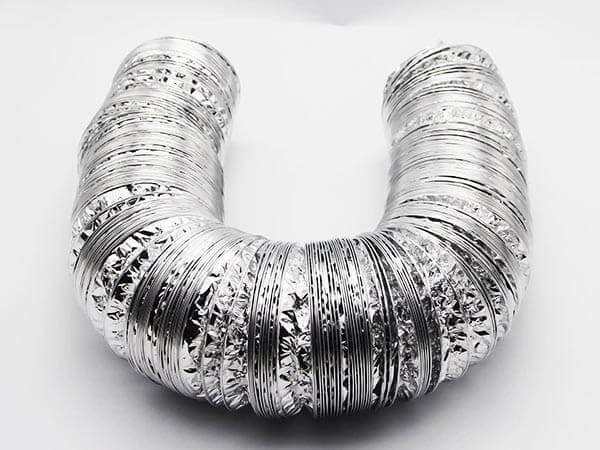
50μm 3003 H14 aluminum foil is a medium-gauge aluminum foil manufactured from 3003 aluminum alloy and supplied in the H14 temper.
With a nominal thickness of 0.05 mm, it combines the lightweight characteristics of aluminum foil with the higher strength and practical forming performance associated with the 3003 alloy.
The material offers a useful balance between strength, corrosion resistance, formability, thermal performance, and barrier properties.
These characteristics make it suitable for applications where very thin foil may lack sufficient mechanical stability, while thicker aluminum sheet would add unnecessary weight or material cost.
The designation itself contains three important pieces of information:
3003 – identifies the aluminum-manganese alloy.
H14 – identifies the work-hardened temper.
50μm – specifies the nominal foil thickness.
This combination is particularly relevant for industrial buyers because alloy, temper, and thickness directly influence processing behavior.
A 50μm foil with a softer temper will not behave exactly like 50μm H14 foil, even when both use the same 3003 alloy.

3003 aluminum foil is a rolled aluminum foil manufactured from AA 3003 aluminum alloy, a non-heat-treatable alloy within the 3xxx aluminum series.
The main alloying element responsible for its characteristic performance is manganese. Compared with commercially pure aluminum grades, 3003 provides higher mechanical strength while retaining good corrosion resistance and useful formability.
This makes 3003 particularly suitable when an application requires more structural stability than soft pure-aluminum foil can provide.
The chemical composition of 3003 aluminum alloy is primarily based on aluminum with manganese as the principal alloying element.
The following table summarizes the commonly specified composition ranges and maximum limits used for 3003 aluminum alloy.
Exact requirements should follow the applicable ASTM, EN, or customer specification.
| Element | Chemical Composition (wt.%) | Function / Effect |
|---|---|---|
| Al | Balance | Base metal; provides low density, corrosion resistance, and thermal conductivity |
| Mn | 1.0–1.5 | Main alloying element; increases strength and improves corrosion resistance |
| Cu | 0.05–0.20 | Provides a moderate increase in strength |
| Fe | ≤ 0.70 | Controlled impurity; influences strength and microstructure |
| Si | ≤ 0.60 | Controlled impurity; affects strength and processing behavior |
| Zn | ≤ 0.10 | Minor element; maintained at a low level to control alloy performance |
| Other Elements | ≤ 0.05 each; ≤ 0.15 total | Controlled to maintain alloy consistency |
| Total Alloying & Impurity Elements | Within applicable standard limits | Ensures consistent processing and finished-product properties |
The H14 temper is one of the most important characteristics of this product because it determines how the 3003 alloy responds mechanically during processing.
Unlike heat-treatable aluminum alloys, 3003 develops its H14 condition primarily through strain hardening or cold working.
The basic principle is straightforward:
Cold deformation increases the strength of the aluminum while reducing some of its ductility.
As the material passes through rolling operations, its crystal structure becomes increasingly resistant to further plastic deformation.
This produces higher strength compared with the annealed O condition.
The letter H identifies a strain-hardened aluminum temper.
The first digit after H indicates the type of strain-hardening treatment, while the second digit indicates the degree of hardening.
For H14:
H = strain-hardened
1 = strain-hardened only
4 = commonly associated with a half-hard level
Therefore, 3003-H14 represents a strain-hardened 3003 alloy rather than a heat-treated alloy.
ASTM's aluminum product standards recognize alloy and temper designations within their specifications, and ASTM documentation specifically discusses H14 and related H1x/H2x temper relationships.
The most useful comparison is often between 3003 H14 and 3003 O.
3003 O has undergone annealing and therefore offers greater ductility and easier forming. H14, by contrast, has higher strength and better resistance to deformation.
This creates a practical trade-off:
| Characteristic | 3003 O | 3003 H14 |
|---|---|---|
| Strength | Lower | Higher |
| Ductility | Higher | Moderate |
| Formability | Excellent | Good |
| Shape retention | Lower | Better |
| Resistance to deformation | Lower | Higher |
| Typical use | Deep forming | General industrial processing |
The appropriate temper depends on the forming depth, bending requirements, tension during converting, and final product design.
At only 0.05 mm, aluminum foil has limited structural rigidity simply because of its small cross-sectional thickness.
The H14 temper helps compensate for this limitation by increasing the material's mechanical strength.
However, increased strength also means that H14 is less ductile than a fully annealed O temper.
Therefore, manufacturers and converters should match the temper to the forming and converting requirements rather than selecting H14 solely because it has higher strength.

A thickness of 50μm, or 0.05 mm, occupies an important position between ultra-thin aluminum foil and thicker foil or sheet products.
The main reason to choose this gauge is its ability to provide a practical combination of material efficiency and mechanical stability.
Reducing foil thickness can lower material consumption, weight, and potentially product cost.
At 50μm, the foil retains the lightweight characteristics expected from aluminum foil while providing more material thickness than many ultra-thin foil products.
This makes it attractive for applications where extremely thin foil is not necessary but conventional sheet material would be unnecessarily heavy.
Aluminum provides an effective barrier against light, moisture, and gases when the foil remains continuous and defect-free.
Therefore, 50μm should not be interpreted as a universal barrier-performance specification. For demanding applications, manufacturers should evaluate the complete structure and applicable test requirements.
50μm aluminum foil can provide a useful balance for converting processes such as:
Slitting
Laminating
Coating
Printing
Forming
Composite production
The H14 temper can further improve dimensional stability during these processes.
The 50μm H14 combination therefore offers a middle-ground solution between flexibility and mechanical stability.
Thickness also directly affects material consumption.
For the same width and length, 50μm foil contains less aluminum than thicker products.
This can reduce the weight of the final product and make it suitable for lightweight construction.
At the same time, the 50μm gauge remains substantial enough for applications requiring better handling characteristics than very thin foil.
The performance of 50μm 3003 H14 aluminum foil results from the interaction of alloy composition, temper, thickness, rolling quality, and surface condition.
The H14 temper gives 3003 foil higher strength than its annealed counterpart.
Key mechanical parameters include:
Tensile strength
Yield strength
Elongation
Hardness
For procurement, buyers should use the mechanical-property limits specified by the applicable standard and product thickness rather than relying on generic values found in product catalogs.
ASTM specifications establish mechanical-property requirements for applicable aluminum products and describe how tensile strength, yield strength, and elongation are evaluated.
Although H14 increases strength, 3003 retains useful ductility.
This makes the material suitable for moderate forming, bending, shaping, and converting operations.
For deep drawing or highly complex forming, however, a softer temper such as O may be more appropriate.
The key is to match the foil temper to the actual deformation required by the finished product.
3003 aluminum generally offers good atmospheric corrosion resistance.
Its aluminum-rich surface naturally develops a thin oxide layer that helps protect the underlying metal from further oxidation.
This property is useful in environments involving:
Humidity
Atmospheric exposure
Thermal systems
Packaging structures
General industrial applications
Actual corrosion performance depends on the environment and the presence of other materials or chemicals.
Aluminum provides good thermal conductivity, which makes 3003 foil useful in thermal management and heat-transfer-related applications.
At 50μm, the foil can provide a lightweight thermal-conductive layer in composite or laminated structures.
However, when maximum electrical or thermal conductivity is the primary requirement, commercially pure aluminum may offer advantages over alloyed grades such as 3003.
A continuous aluminum foil layer provides strong protection against light and can serve as a barrier against moisture and gases.
The effectiveness of the final barrier depends heavily on foil integrity.
For this reason, pinholes and microscopic defects are critical quality-control factors for thin-gauge foil.
For downstream processing, surface quality can be as important as mechanical properties.
A high-quality 50μm foil should maintain a controlled surface condition with minimal:
Scratches
Stains
Oil residues
Wrinkles
Roll marks
Edge cracks
Other visible defects
Surface requirements should be agreed upon before production, especially when the foil will undergo printing, coating, or lamination.

Producing 50μm 3003 H14 aluminum foil requires precise control of alloy composition, rolling reduction, thickness, temper, and surface quality throughout the production process.
Aluminum and alloying elements are melted according to the required 3003 composition.
The molten metal is chemically analyzed and then cast into suitable slabs or feedstock for rolling.
The cast material may undergo homogenization to improve metallurgical consistency.
Hot rolling then reduces the material thickness and prepares it for subsequent cold rolling.
Cold rolling gradually reduces the aluminum strip to the required gauge.
For 50μm foil, precise control of rolling reduction, tension, flatness, and surface condition is essential to maintain uniform thickness and stable quality.
Depending on the rolling schedule, intermediate annealing may restore ductility and allow further thickness reduction.
The process must be carefully controlled to achieve the required final mechanical properties.
The final cold-rolling passes bring the foil to the target 50μm thickness while establishing the required H14 temper through controlled work hardening.
The finished jumbo coil can be slit into customized widths. Quality inspection typically covers alloy composition, thickness, width, tensile properties, elongation, surface condition, and edge quality.
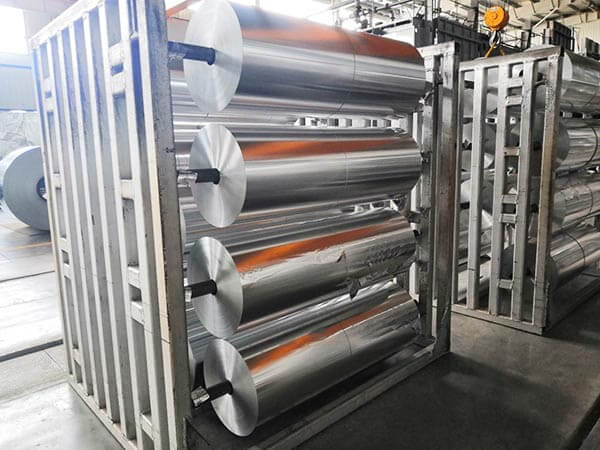
Finally, the 50μm foil is carefully packed with moisture, edge, and mechanical protection to prevent damage during storage and international transportation.
The surface condition of 50μm 3003 H14 aluminum foil directly affects its appearance, converting performance, adhesion, and suitability for downstream processing.
The required finish should therefore be defined according to the final application.
Mill finish is the standard surface condition produced during aluminum rolling.
It provides a practical surface for general industrial applications and can serve as the base for subsequent coating, laminating, or other treatments.
For applications where appearance is important, buyers should specify acceptable surface defects and visual requirements before production.
Depending on rolling conditions and the finishing process, 3003 aluminum foil can be supplied with different surface appearances.
A bright surface provides higher visual reflectivity and is useful when appearance or light reflection matters.
A matte surface offers a less reflective appearance and may be preferred for certain laminated, printed, or industrial products.
Surface requirements should be clearly defined because "bright" and "matte" can represent different commercial requirements between suppliers.
Jumbo 50μm foil coils can be slit into narrower widths according to the customer's equipment and final product dimensions.
For high-speed converting, stable coil winding and clean edges are particularly important.
50μm 3003 H14 aluminum foil can be laminated with materials such as polymer films, paper, or other substrates to create multilayer structures.
The foil surface may require appropriate cleaning or treatment to achieve reliable adhesive bonding.
The foil can also serve as a substrate for protective, functional, or decorative coatings.
Coating and printing requirements should consider surface cleanliness, coating adhesion, curing conditions, and the intended end use.
Where required, aluminum foil can undergo embossing or forming to create a specific surface pattern or geometry.
However, the H14 temper provides higher strength than soft-temper foil, so the forming depth and deformation level should be evaluated before selecting the material.

A technical specification for 50μm 3003 H14 aluminum foil should cover more than nominal thickness.
Buyers normally define the alloy, temper, dimensions, surface condition, mechanical requirements, coil configuration, and applicable standards.
| Parameter | Specification / Typical Value |
|---|---|
| Alloy | 3003 |
| Temper | H14 |
| Nominal Thickness | 50 μm / 0.050 mm |
| Thickness in Inch | 0.00197 in. |
| Density | Approx. 2.73 g/cm³ |
| Tensile Strength | Approx. 138–179 MPa* |
| Yield Strength (0.2%) | Approx. ≥117 MPa* |
| Elongation | Typically ≥2–4%* |
| Surface | Mill Finish / Bright / Matte |
| Form | Jumbo Coil / Slit Coil |
| Width | Customized |
| Width Tolerance | According to agreed specification |
| Core ID | 76 / 152 / 203 mm or Customized |
| Coil OD | Customized |
| Coil Weight | Customized |
| Processing Options | Slitting / Laminating / Coating / Printing |
| Applicable Standards | ASTM / EN / JIS / Customer Specification |
The combination of 3003 alloy, H14 temper, and 50μm thickness makes this foil suitable for applications that require a balance of lightweight construction, moderate strength, corrosion resistance, and barrier or thermal functionality.
Aluminum foil can provide an effective barrier against light, moisture, and gases when the foil layer remains continuous and properly processed.
50μm 3003 H14 foil can therefore be used as a material layer in selected:
Flexible packaging structures
Food packaging components
Lids and covers
Laminated packaging
Heat-resistant packaging structures
For direct food-contact applications, the finished product must comply with the applicable food-contact regulations in the destination market. Alloy selection alone does not establish regulatory compliance.
Aluminum foil is widely used as a reflective and barrier layer in insulation systems.
50μm foil can be incorporated into multilayer insulation structures where the aluminum layer contributes to:
Radiant heat reflection
Moisture resistance
Vapor barrier performance
Lightweight construction
The actual thermal performance depends on the complete insulation assembly rather than foil thickness alone.
3003 is widely associated with general-purpose applications and heat-transfer equipment. The Aluminum Association specifically identifies 3003 as a popular alloy for applications including heat exchangers and cooking utensils.
In HVAC and refrigeration-related products, aluminum's corrosion resistance, thermal conductivity, low density, and formability can make it useful in selected foil or laminated components.
The exact alloy and temper should be selected according to the forming, brazing, thermal, and environmental requirements of the specific component.

50μm 3003 H14 foil can function as a metallic barrier layer in composite materials.
Laminating aluminum foil with polymer films, paper, or other substrates can create structures with improved resistance to:
Moisture
Light
Gas transmission
External contamination
This makes aluminum foil useful in various industrial packaging and protective structures.
Aluminum provides good electrical and thermal conductivity, low density, and corrosion resistance.
50μm 3003 H14 foil can therefore be considered for selected electrical or electronic components where moderate strength and dimensional stability are more important than maximum electrical conductivity.
Where electrical conductivity is the primary performance requirement, commercially pure aluminum grades may be more appropriate.
| Property | 50μm 3003 H14 | 3003 O | 1050 / 1060 | 3004 H14 |
|---|---|---|---|---|
| Alloy Series | 3xxx | 3xxx | 1xxx | 3xxx |
| Temper | H14 | O | Commonly O / H14 | H14 |
| Nominal Thickness | 50 μm | Customized | Customized | Customized |
| Main Alloying Element | Mn | Mn | Minimal alloying | Mn + Mg |
| Strength | Moderate | Lower | Generally lower | Generally higher |
| Formability | Good | Excellent | Excellent in soft temper | Good |
| Ductility | Moderate | High | High | Moderate |
| Corrosion Resistance | Good | Good | Good | Good |
| Thermal Conductivity | Good | Good | Generally higher | Good |
| Electrical Conductivity | Good | Good | Generally higher | Good |
| Shape Retention | Good | Lower | Lower in soft temper | Good |
| Deep Forming | Limited compared with O temper | Excellent | Excellent in soft temper | Good |
| Processing Stability | Good | High flexibility but lower strength | Depends on temper | Good |
| Typical Applications | Industrial foil, insulation, laminated materials, packaging | Deep-forming and highly ductile applications | Electrical, thermal, packaging, general-purpose foil | Higher-strength packaging and industrial applications |
| Main Selection Consideration | Balance of strength, formability, and 50μm material efficiency | Maximum ductility and forming ability | Purity, conductivity, and ductility | Higher strength within 3xxx series |
Henan Huawei Aluminum Co., Ltd. is an experienced aluminum manufacturer and supplier specializing in aluminum sheet, plate, coil, foil, strip, and circle products.
For 50μm 3003 H14 aluminum foil, Huawei can customize key specifications including alloy, temper, thickness, width, coil dimensions, surface condition, and downstream processing requirements.
The 50μm thickness equals 0.05 mm, providing a practical balance between material efficiency, flexibility, strength, and handling performance.
For 50μm aluminum foil, thickness consistency is particularly important. Gauge variation can affect roll weight, tension control, lamination, coating, slitting, and downstream forming.
Huawei applies controlled rolling and inspection procedures to maintain consistent foil thickness and surface quality.
Depending on the application, customers can select mill finish, bright, matte, or other suitable surface conditions.
Slitting and other value-added processing can also be arranged according to production requirements.
Different applications require different foil configurations. A packaging converter may focus on surface quality and lamination performance, while an industrial user may prioritize coil weight, width, winding quality, and processing stability.
Huawei can customize:
Alloy: 3003
Temper: H14
Thickness: 50μm / 0.05 mm
Width: Customized
Core ID: 76 mm, 152 mm, or customized
Surface: Mill finish, bright, matte, etc.
Coil weight: Customized
Coil OD: Customized
Processing: Slitting, laminating, coating, printing, etc.
Packaging: Customized export packaging
This approach allows buyers to obtain foil that matches their production equipment and processing requirements.
Quality control for 50μm 3003 H14 aluminum foil covers more than alloy composition.
Dimensional control focuses on thickness, width, coil dimensions, and agreed tolerances.
Mechanical testing can include tensile strength, yield strength, and elongation according to the applicable product specification.
Surface inspection helps identify scratches, rolling marks, oil stains, edge defects, and other surface problems that could affect subsequent processing.
Coil quality also matters. Winding tension, edge condition, telescoping, roll stability, and overall coil appearance can influence slitting, coating, laminating, and automated production.
Huawei can also support inspection documentation and third-party inspection requirements for suitable export orders.

The price of 50μm 3003 H14 aluminum foil depends on more than the nominal thickness.
Aluminum market prices, alloy and temper, processing requirements, order quantity, surface condition, packaging, and logistics can all affect the final quotation.
The price of primary aluminum represents an important part of the final foil cost.
Changes in international aluminum market prices can therefore influence the quotation for 3003 aluminum foil.
When comparing suppliers, buyers should distinguish between the aluminum material component and the manufacturer's processing cost.
3003 H14 aluminum foil requires controlled alloy preparation and cold working to achieve the required temper.
Compared with 3003-O foil, H14 material requires additional control over the work-hardening process and final mechanical properties.
Therefore, alloy and temper requirements can influence the final production cost.
The nominal thickness of this product is 50μm, but the required thickness tolerance also affects production difficulty.
Standard commercial tolerances and tighter customer-specific tolerances may involve different levels of process control and inspection.
For precision applications, buyers should specify the required tolerance when requesting a quotation.
Width has a direct influence on processing.
A wide jumbo coil may require fewer processing steps, while multiple narrow slit coils require additional slitting, rewinding, edge control, inspection, and packaging.
Therefore, the requested finished width and number of slit rolls can affect the unit price.
Coil configuration also affects the quotation.
Small slit coils and large industrial coils require different winding, handling, and packaging arrangements.
For export shipments, packaging may include moisture protection, edge protection, pallets, steel straps, and other measures according to transportation requirements.
Standard mill-finish foil generally requires fewer processing steps.
If the customer requires a specific bright or matte surface, coating, lamination, printing, or another value-added process, the additional processing can increase the overall cost.
Order quantity can significantly affect the unit price.
Larger orders can distribute production setup, testing, slitting, packaging, and other fixed costs over a greater volume.
Small trial orders may therefore have a higher unit cost than large-volume orders.
International quotations can vary depending on the selected delivery terms.
Common terms include:
EXW
FOB
CFR
CIF
Freight, insurance, port charges, and destination-related costs can all affect the final landed cost.
Some customers require standard mill certificates, while others may require additional inspection reports or third-party inspection.
These requirements can increase procurement costs but may be necessary for specific industrial applications.
50μm 3003 H14 aluminum foil combines a relatively thin gauge with the higher strength and improved dimensional stability provided by the H14 temper.
The 3003 aluminum alloy offers good corrosion resistance, useful formability, and balanced mechanical properties.
The H14 temper increases strength compared with the annealed condition while retaining practical flexibility for many processing applications.
At 50μm / 0.05 mm, the foil provides a useful balance between material consumption and handling performance.
It can be used where controlled thickness, moderate strength, flexibility, and corrosion resistance are important.
For long-term procurement, price should not be the only consideration.
Thickness consistency, surface quality, mechanical properties, processing stability, batch consistency, packaging, and delivery reliability can all influence the actual purchasing value of the material.
Henan Huawei Aluminum Co., Ltd. can provide customized 3003 H14 aluminum foil specifications and support different widths, coil configurations, surface conditions, processing requirements, and export packaging solutions.
It is aluminum foil made from 3003 aluminum alloy in the H14 temper, with a nominal thickness of 50μm (0.05 mm). It offers a practical balance of strength, flexibility, corrosion resistance, and material efficiency.
3003 H14 has higher strength and better shape retention, while 3003 O offers higher ductility and easier forming. H14 is suitable when moderate strength and dimensional stability are important.
Yes. Suppliers can customize width, coil weight, core diameter, surface finish, slitting, packaging, and other specifications according to the customer's production requirements.
Common options include mill finish, bright finish, and matte finish. Lamination, coating, and printing can also be available for suitable applications.
50μm 3003 H14 aluminum foil can be used for thermal insulation, industrial packaging, HVAC and refrigeration materials, laminated products, and other industrial applications requiring controlled thickness and moderate strength.
The main factors include aluminum market price, alloy and temper, thickness tolerance, width, order quantity, slitting, surface treatment, coil specifications, packaging, inspection, and delivery terms.
Provide the supplier with the alloy, temper, thickness, width, surface, coil requirements, quantity, application, and destination. Complete specifications allow the manufacturer to calculate the material and processing costs more accurately.
Henan Huawei Aluminum can supply customized 3003 H14 aluminum foil with controlled thickness, surface quality, coil specifications, and processing options. The company also provides technical support and export-oriented supply services for international customers.