



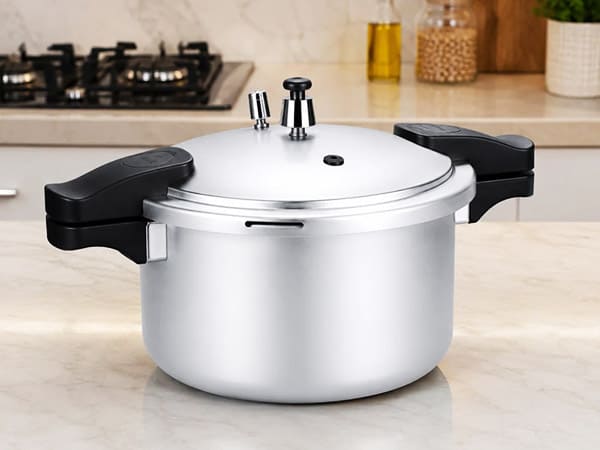
3003 Aluminum Circle For Pressure Cooker
1. Introduction
3003 Aluminum Circle for Pressure Cooker is a circular aluminum blank used to manufacture pressure cooker bodies, inner pots, bottoms, and other formed cookware components.
The material must provide good deep-drawing performance, stable mechanical properties, corrosion resistance, and sufficient strength for the finished product.
3003 is a 3xxx-series aluminum-manganese alloy. It offers higher strength than many 1xxx-series aluminum grades while maintaining good formability, making it suitable for cookware and deep-drawn applications.
For pressure cooker manufacturing, the alloy alone is not enough to determine performance.
Temper, thickness, diameter, grain structure, surface quality, and forming conditions all affect the final result.
3003 O temper is commonly considered when deep drawing and high ductility are priorities, while harder tempers can be selected for less severe forming and greater rigidity.
This article explains the key characteristics, forming performance, specifications, and selection considerations of 3003 aluminum circles for pressure cooker production.
2. What Is 3003 Aluminum Circle for Pressure Cooker?
2.1 Understanding 3003 Aluminum Alloy
3003 is a 3xxx-series aluminum-manganese alloy and is classified as a non-heat-treatable aluminum alloy.
Unlike heat-treatable alloys, its strength is mainly controlled through alloy composition, cold working, and temper rather than precipitation hardening.
Manganese is the principal alloying addition. It increases the strength of aluminum while preserving useful ductility and corrosion resistance.
This makes 3003 stronger than many 1xxx-series commercially pure aluminum grades while retaining the forming capability required for cookware production.
For pressure cooker applications, this balance is important.
The material must deform sufficiently during forming without excessive cracking, but the finished body also needs enough rigidity to maintain its designed geometry.

2.2 What Is a 3003 Aluminum Circle?
A 3003 aluminum circle is a round, flat aluminum blank produced from aluminum sheet or coil through precision blanking or related processing.
The circular blank becomes the starting material for a forming operation.
During deep drawing, a punch pushes the blank into a die, causing the material to flow from the flange area into the side wall and bottom of the finished component.
This makes the quality of the original circle important. Diameter, thickness, flatness, edge condition, surface quality, and mechanical properties can all influence forming stability.
Commercial 3003 circles are available in various diameters and thicknesses, with specifications customized according to the final component and forming process.
Common product listings cover O and H-series tempers and a broad range of dimensions.
2.3 How Is the Aluminum Circle Used in Pressure Cooker Manufacturing?
The circle can serve as the initial blank for producing:
Pressure cooker bodies
Inner pots or liners
Pressure cooker bottoms
Deep-drawn cookware components
Other cylindrical or curved aluminum parts
For a deep-drawn pressure cooker body, the manufacturing sequence generally follows:
3003 aluminum circle → blank positioning → deep drawing → redrawing if required → trimming → forming/calibration → surface treatment → final inspection
The exact process depends on the cooker diameter, forming depth, wall geometry, required thickness, tooling design, and production equipment.
2.4 Why Does the Circle Form Matter?
Using a circular blank provides a controlled starting geometry for rotationally symmetrical components.
It allows manufacturers to calculate material utilization and design the blank around the required drawing dimensions.
More importantly, the blank should deform consistently around its circumference.
Variations in material properties or edge quality can contribute to uneven material flow, earing, wrinkles, or localized thinning during forming.
Therefore, a pressure cooker manufacturer should evaluate a 3003 aluminum circle as a forming material, rather than simply as a round piece of aluminum.
3. Why Choose 3003 Aluminum Circle for Pressure Cookers?
3003 aluminum offers a practical balance of formability, strength, corrosion resistance, thermal conductivity, and weight, making it well suited to pressure cooker bodies and other deep-drawn cookware components.
3.1 Good Deep-Drawing Performance
Pressure cooker bodies require significant deformation during deep drawing.
3003, particularly in a soft temper such as O, provides good ductility and allows the material to flow into the die with a lower risk of cracking and excessive thinning.
3.2 Balanced Strength and Ductility
Compared with 1xxx-series aluminum, 3003 provides higher strength while retaining good formability.
This balance helps the finished cooker maintain its shape and rigidity without making the material unnecessarily difficult to form.
3.3 Good Corrosion Resistance
3003 provides good corrosion resistance for general cookware environments involving moisture, steam, and common food ingredients.
Appropriate surface treatments or coatings can provide additional protection when required.
3.4 Good Thermal Performance
Aluminum provides efficient heat transfer, helping pressure cookers heat quickly and distribute heat more evenly.
3003 maintains useful thermal conductivity while offering greater strength than commercially pure aluminum grades.
3.5 Lightweight Construction
With aluminum's relatively low density, 3003 aluminum circles can help manufacturers produce pressure cookers that are lighter and easier to handle than comparable steel constructions.
3.6 Flexible Temper Selection
3003 is available in different tempers to match different forming requirements.
O temper is generally preferred for demanding deep drawing, while H12 or H14 can be considered when the component requires higher strength and less severe forming.
Overall, 3003 aluminum circle is valuable not because it offers the highest strength or thermal conductivity, but because it provides a balanced combination of forming performance, mechanical strength, corrosion resistance, heat transfer, and manufacturing efficiency.

4. Key Specifications of 3003 Aluminum Circle for Pressure Cooker
The specifications of 3003 aluminum circles should be matched to the pressure cooker design, forming depth, tooling, and production process.
| Parameter | Typical Specification |
|---|---|
| Alloy | 3003 |
| Alloy Series | 3xxx Series Aluminum-Manganese |
| Temper | O, H12, H14 |
| Typical Temper for Deep Drawing | O |
| Thickness | 1.0–6.0 mm |
| Common Pressure Cooker Thickness | 2.0–4.5 mm |
| Diameter | 180–650 mm |
| Larger Diameter | Up to 1,200 mm or customized |
| Product Form | Aluminum Circle / Disc |
| Forming Process | Deep Drawing, Stamping, Spinning |
| Surface | Mill Finish / Bright / Clean Surface |
| Edge | Smooth, Burr-Free |
| Thickness Tolerance | According to applicable standard or customer drawing |
| Diameter Tolerance | According to customer specification |
| Flatness | Controlled for stable feeding and forming |
| Grain Structure | Fine and uniform |
| Formability | Excellent in O temper |
| Thermal Conductivity | Approx. 190 W/m·K |
| Density | Approx. 2.73 g/cm³ |
| Typical Application | Pressure Cooker Body, Inner Pot, Bottom |
| Applicable Standards | ASTM B209, EN 485, GB/T 3880 or customer specification |
| Packaging | Export Standard / Customized |
5. 3003 Aluminum Chemical Composition
3003 is a non-heat-treatable Al-Mn alloy. Manganese is its principal alloying element, while small controlled amounts of copper, iron, silicon, and zinc help define the alloy's processing and performance characteristics.
5.1 Typical Chemical Composition of 3003 Aluminum
| Element | Composition |
|---|---|
| Aluminum (Al) | Balance |
| Manganese (Mn) | 1.0–1.5% |
| Copper (Cu) | 0.05–0.20% |
| Iron (Fe) | ≤0.70% |
| Silicon (Si) | ≤0.60% |
| Zinc (Zn) | ≤0.10% |
| Other, each | ≤0.05% |
| Other, total | ≤0.15% |
These limits correspond to commonly referenced AA 3003 composition data.
Exact limits should always be verified against the standard specified in the purchase order.
5.2 Role of the Main Alloying Elements
Manganese is the key addition in 3003. It increases strength while maintaining useful ductility, making the alloy suitable for forming applications.
Copper is controlled at a relatively low level and contributes to the alloy's strength characteristics.
Iron and silicon are controlled because they influence the alloy's microstructure and forming behavior.
Their levels need to remain within the applicable specification for consistent production.
For pressure cooker circles, consistent chemical composition is important because it supports stable mechanical properties and predictable behavior during deep drawing.

6. Common Tempers of 3003 Aluminum Circle for Pressure Cooker
Temper selection has a direct influence on strength, elongation, hardness, and deep-drawing performance.
Therefore, the same 3003 alloy can behave very differently depending on its temper.
6.1 3003 O Temper
3003-O is the annealed condition and provides the highest ductility among the commonly used tempers.
It is generally the first choice for pressure cooker circles requiring substantial deep drawing because the softer material can accommodate greater plastic deformation.
Typical characteristics include:
Excellent formability
High ductility
Low strength compared with H tempers
Good resistance to forming cracks
Suitable for deep-drawn cooker bodies
6.2 3003 H12 Temper
H12 is a strain-hardened condition with higher strength than O temper while retaining useful formability.
It can be considered when the pressure cooker component requires a balance between forming capability and increased rigidity.
Representative AA data for 3003-H12 shows tensile strength varying with product thickness, illustrating why mechanical properties should always be specified together with thickness and applicable standard.
6.3 3003 H14 Temper
H14 provides a higher strength level than H12, with correspondingly lower ductility.
It may be suitable for components with relatively moderate forming requirements where additional rigidity is desirable.
Representative data for 3003-H14 shows higher strength than softer H12 material, while elongation decreases as the material becomes more heavily strain hardened.
6.4 Temper Selection for Pressure Cooker Production
| Temper | Formability | Strength | Typical Direction |
|---|---|---|---|
| 3003-O | Excellent | Low | Deep drawing / complex forming |
| 3003-H12 | Good | Medium | Moderate forming + higher rigidity |
| 3003-H14 | Moderate | Medium–High | Less severe forming + greater rigidity |
For pressure cooker bodies with substantial drawing depth, 3003-O is generally the most suitable option.
H12 or H14 should be selected when the component geometry and forming process allow the use of a harder material.
Importantly, temper should not be selected independently.
Thickness, blank diameter, drawing depth, tooling design, lubrication, and required final wall thickness all need to be considered together.
7. Mechanical Properties of 3003 Aluminum Circle
The mechanical properties of 3003 aluminum circle directly affect its deep-drawing performance, forming stability, and final pressure cooker strength.
For cookware applications, tensile strength should not be considered separately from elongation and temper.
7.1 Typical Mechanical Properties
| Property | 3003-O | 3003-H12 | 3003-H14 |
|---|---|---|---|
| Temper | Annealed | Strain Hardened | Strain Hardened |
| Tensile Strength | Approx. 95–130 MPa* | Approx. 70–120 MPa* | Approx. 85–120 MPa* |
| Yield Strength | Approx. 35–45 MPa* | Higher than O | Higher than H12 |
| Elongation | Approx. 25–35%* | ≥4%* | ≥2%* |
| Formability | Excellent | Good | Moderate |
| Relative Strength | Low | Medium | Medium–High |
| Typical Use | Deep drawing | Moderate forming | Higher rigidity |
*Representative values from industry data; exact requirements vary with thickness, product form, standard, and test method.
7.2 Tensile Strength and Yield Strength
Tensile strength indicates the material's resistance to fracture, while yield strength indicates when permanent plastic deformation begins.
For a pressure cooker circle, higher strength can improve the rigidity of the finished component.
However, excessive strength can reduce the forming margin. Therefore, the target is not maximum strength but an appropriate strength–ductility balance.
7.3 Elongation and Deep-Drawing Performance
Elongation is particularly important when manufacturing pressure cooker bodies through deep drawing.
A higher elongation generally provides greater tolerance for plastic deformation and helps reduce the risk of cracking during forming.
This is why 3003-O is commonly considered for demanding deep-drawing applications.
7.4 Mechanical Consistency
For mass production, consistent properties between circles can be as important as the nominal strength values.
Stable thickness, temper, grain structure, and mechanical properties help maintain consistent material flow and reduce adjustments to forming equipment.

8. Manufacturing Process of 3003 Aluminum Circle
Producing a pressure-cooker-grade aluminum circle involves more than simply cutting a round shape from aluminum sheet.
The manufacturing process must control alloy composition, rolling structure, annealing condition, dimensional accuracy, and edge quality.
8.1 Alloy Melting and Casting
Aluminum and alloying elements are melted according to the required 3003 composition.
The molten metal undergoes refining and degassing before being cast into slabs.
Consistent chemical composition provides the foundation for stable mechanical and forming properties.
8.2 Homogenization
The cast slab may undergo homogenization treatment to reduce chemical segregation and improve structural uniformity before rolling.
This stage helps establish a more stable metallurgical structure for subsequent processing.
8.3 Hot Rolling
The slab passes through multiple hot-rolling stages to reduce its thickness and develop the required material structure.
Hot rolling is particularly important for cookware-grade aluminum because the resulting grain structure influences later annealing and deep-drawing behavior.
8.4 Cold Rolling
Cold rolling can be used to achieve the required final thickness, dimensional tolerance, and surface quality.
The amount of cold work must be controlled carefully because excessive work hardening can reduce ductility.
8.5 Annealing and Temper Control
Annealing is one of the most important steps for deep-drawing circles.
For 3003-O, controlled annealing restores ductility and develops a recrystallized structure suitable for substantial deformation.
The objective is to obtain consistent hardness, elongation, and forming behavior across the material.
8.6 Precision Circle Blanking
The processed aluminum coil or sheet is cut into circular blanks using punching, shearing, or other precision blanking equipment.
The key controls include:
Circle diameter
Thickness
Dimensional tolerance
Flatness
Edge condition
Burr control
A clean and uniform edge is particularly important because cracks can initiate at poorly formed or damaged edges during subsequent drawing.
8.7 Surface Inspection and Finishing
Each circle should be inspected for major surface defects such as:
Scratches
Oil contamination
Oxidation
Roll marks
Dents
Uneven surface appearance
A clean and consistent surface also supports subsequent polishing, coating, anodizing, or other finishing operations.
8.8 Final Quality Inspection
Before shipment, manufacturers typically verify:
Chemical composition → Thickness → Diameter → Mechanical properties → Temper → Surface → Edge → Flatness → Packaging
This process ensures that the aluminum circles provide predictable performance during pressure cooker forming.

9. 3003 vs. 1050 vs. 1060 vs. 5052 Aluminum Circle
For pressure cooker manufacturing, alloy selection should consider more than strength.
Formability, elongation, thermal conductivity, corrosion resistance, density, and temper all influence the performance of the final cookware component.
| Parameter | 3003 Aluminum Circle | 1050 Aluminum Circle | 1060 Aluminum Circle | 5052 Aluminum Circle |
|---|---|---|---|---|
| Alloy Series | 3xxx | 1xxx | 1xxx | 5xxx |
| Density | ~2.73 g/cm³ | ~2.70 g/cm³ | ~2.70 g/cm³ | ~2.68 g/cm³ |
| Thermal Conductivity | ~190 W/m·K | ~229 W/m·K | ~230 W/m·K | ~138 W/m·K |
| Typical Temper for Deep Drawing | O | O | O | O |
| Typical Tensile Strength | ~95–200 MPa* | ~60–95 MPa* | ~60–95 MPa* | ~170–290 MPa* |
| Typical Yield Strength | ~35–185 MPa* | ~15–35 MPa* | ~15–35 MPa* | ~70–255 MPa* |
| Typical Elongation | ~4–30%* | ~25–40%* | ~25–40%* | ~10–25%* |
| Relative Strength | Medium | Low | Low | Medium–High |
| Formability | Very Good–Excellent | Excellent | Excellent | Good–Very Good |
| Deep-Drawing Performance | Excellent in O temper | Excellent | Excellent | Good |
| Corrosion Resistance | Good–Very Good | Very Good | Very Good | Excellent |
| Heat Transfer | Good | Excellent | Excellent | Moderate |
| Finished-Part Rigidity | Medium | Low | Low | High |
| Typical Pressure Cooker Positioning | Balanced choice | High formability | High formability | Higher-strength option |
10. Conclusion
3003 Aluminum Circle for Pressure Cooker offers a practical combination of deep-drawing formability, moderate strength, corrosion resistance, thermal conductivity, and lightweight construction.
These characteristics make 3003 a suitable material for pressure cooker bodies, lids, inner pots, and other formed cookware components.
Compared with 1050 and 1060, 3003 provides higher strength and better structural rigidity while maintaining good forming performance.
Compared with 5052, 3003 generally offers a more balanced combination of formability and strength for deep-drawn cookware.
However, alloy selection alone does not determine the final forming result.
Temper, thickness, blank diameter, grain structure, surface quality, edge condition, tooling, lubrication, and forming depth must be considered together.
For pressure cooker manufacturers, the most important approach is to select a 3003 aluminum circle specification that matches the actual production process.
Huawei Aluminum can provide customized 3003 circles according to dimensions, temper, surface requirements, forming method, and inspection specifications.
FAQs
Q1. Is 3003 aluminum circle suitable for pressure cookers?
Yes. 3003 aluminum offers good deep-drawing performance, moderate strength, corrosion resistance, and good thermal conductivity, making it suitable for pressure cooker bodies and other cookware components.
Q2. Which temper is best for deep drawing?
3003-O is generally preferred for deep drawing because its annealed condition provides high ductility. H12 and H14 can be considered when higher strength or rigidity is required.
Q3. What thickness is commonly used?
The required thickness depends on the cooker design, diameter, forming depth, and wall thickness. 2.0–4.5 mm is a practical reference range for some pressure cooker applications, but the final specification should follow the customer's requirements.
Q4. How does 3003 compare with 1050, 1060, and 5052?
3003 provides a good balance of formability and strength. 1050 and 1060 offer higher ductility and thermal conductivity, while 5052 provides higher strength and excellent corrosion resistance.
Q5. Can Huawei provide customized 3003 aluminum circles?
Yes. Huawei Aluminum can customize alloy, temper, diameter, thickness, surface condition, edge quality, packaging, and inspection requirements according to the customer's specifications.
Q6. What information is needed for a quotation?
Provide the alloy, temper, diameter, thickness, quantity, application, forming process, and applicable standard. A product drawing or forming requirement is also helpful for precise material selection.
Send Inquiry
