




Marine Grade Aluminium Checkered Plate For Decks, Walkways & Platforms
1. Introduction
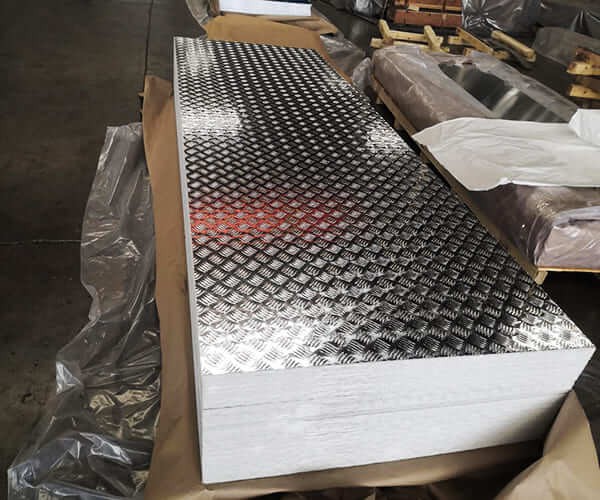
Marine grade aluminium checkered plate (also called tread plate, chequer plate or diamond plate) combines a patterned, anti-slip surface with the corrosion resistance and light weight of marine aluminium alloys.
Typical alloys used for marine checkered plate include 5083, 5086, 5754 and 5052; among these, 5083 is preferred where maximum strength and fatigue resistance are required and 5754/5052 are used where formability and cost are dominant considerations.
Checkered plate is specified for decks, walkways, ramps, stairs, access platforms and many accessory applications because it improves safety, drains water, and is easy to fabricate and repair.
Key technical tradeoffs are corrosion resistance vs. strength, pattern height vs. slip performance, and initial cost vs. lifecycle cost.

2. What is a Marine Grade Aluminium Checkered Plate?
A marine grade aluminium checkered plate (often called tread plate, chequer plate or diamond plate) is a flat aluminium sheet that has a raised pattern on one or both faces designed to provide anti-slip traction, local stiffening and an attractive/robust walking surface.
When described as marine grade, the plate is produced from alloys, tempers and finishes selected and controlled to perform reliably in salt-laden atmospheres, splash zones and other marine exposures.
Core defining features
Patterned surface: raised bars, diamonds, or rounded treads that increase friction underfoot and improve local bending stiffness compared with smooth sheet of the same thickness.
Marine alloys: produced from aluminium alloys chosen for seawater resistance and structural performance (commonly 5xxx series such as 5083, 5086, 5754, 5052).
Tempering and QA: supplied in tempers appropriate to the application (e.g., H111/H116 for 5083, H22 for some 5754 plates) and accompanied by mill test certificates and, when required, class-society documentation.
Surface finish & treatments: available in mill finish, with optional conversion coatings, anodizing, primers and paint or non-slip coatings applied for enhanced durability and safety.
Common Alloys of Marine Grade Aluminium Checkered Plate
Marine grade aluminium checkered plate are most commonly produced from 5xxx-series aluminium–magnesium alloys, which are non-heat-treatable and known for their excellent corrosion resistance in chloride-rich environments.
| EN / ISO Alloy Designation | AA (ASTM) Equivalent | Typical Temper | Key Characteristics | Typical Marine Use |
|---|---|---|---|---|
| EN AW-5083 | AA 5083 | H111 / H116 / H321 | High strength, excellent seawater corrosion resistance, good fatigue performance | Heavy-duty decks, commercial vessels, offshore platforms |
| EN AW-5086 | AA 5086 | H111 | Very good corrosion resistance, slightly lower strength than 5083, good weldability | Hull structures, decks, workboats |
| EN AW-5754 | AA 5754 | H22 / H114 | Medium strength, excellent formability, good corrosion resistance | Small craft decks, superstructures, access platforms |
| EN AW-5052 | AA 5052 | H32 / H34 | Good corrosion resistance, high ductility, easy forming | Walkways, interior decks, tanks, light-duty marine components |
Note: Alloys such as 5083 and 5086 are often required for classed vessels due to their higher strength and fatigue resistance, while 5754 and 5052 are favored for cost efficiency and forming performance in non-primary structural applications.
Typical Surface Patterns and Forms
Marine grade aluminium checkered plate is supplied with various tread designs, depending on functional and safety requirements:
Diamond / lozenge pattern – classic all-purpose anti-slip design
3-bar / 5-bar pattern – directional grip, suitable for ramps and rolling loads
Round or pebble tread – lower profile, comfortable underfoot, easier to clean
Plates are usually patterned on one face, with the reverse side remaining smooth to facilitate welding, bonding, or installation.

Typical Dimensions and Physical Characteristics
Thickness range: approximately 0.8 mm to 12 mm
Common deck thicknesses: 2.0 – 8.0 mm
Standard widths: 1000 mm, 1250 mm, 1500 mm, up to 2500 mm
Density: ~2.66–2.70 g/cm³ (depending on alloy)
Pattern height: typically 0.5–3.0 mm, depending on plate thickness and pattern type
3. Properties of Marine Grade Aluminium Checkered Plate
Chemical Composition
| Element (wt. %) | 5083 | 5086 | 5754 | 5052 |
|---|---|---|---|---|
| Aluminium (Al) | Balance | Balance | Balance | Balance |
| Magnesium (Mg) | 4.0 – 4.9 | 3.5 – 4.5 | 2.6 – 3.6 | 2.2 – 2.8 |
| Manganese (Mn) | 0.4 – 1.0 | 0.2 – 0.5 | 0.3 – 0.5 | 0.1 – 0.5 |
| Silicon (Si) | ≤ 0.40 | ≤ 0.40 | ≤ 0.40 | ≤ 0.25 |
| Iron (Fe) | ≤ 0.40 | ≤ 0.40 | ≤ 0.40 | ≤ 0.40 |
| Chromium (Cr) | 0.05 – 0.25 | ≤ 0.25 | ≤ 0.30 | ≤ 0.15 |
| Copper (Cu) | ≤ 0.10 | ≤ 0.10 | ≤ 0.10 | ≤ 0.10 |
| Zinc (Zn) | ≤ 0.25 | ≤ 0.25 | ≤ 0.20 | ≤ 0.10 |
| Titanium (Ti) | ≤ 0.15 | ≤ 0.15 | ≤ 0.15 | ≤ 0.15 |
Mechanical properties
Mechanical properties vary with alloy, temper, and thickness. The table below gives typical engineering ranges you can use for preliminary design and comparison. Always specify minimum guaranteed values on drawings and request MTCs.
| Alloy & typical temper | 0.2% Proof / Yield (MPa) | Ultimate Tensile (UTS, MPa) | Elongation (%) | Brinell Hardness (HB) |
|---|---|---|---|---|
| 5083 H111 / H116 | 115 – 150 | 275 – 350 | ≥ 10 – 16 | ~70 – 85 |
| 5086 H111 | 110 – 135 | 260 – 320 | ≥ 10 – 15 | ~65 – 80 |
| 5754 H22 / H114 | 120 – 185 (H22 varies) | 220 – 290 | 7 – 15 | ~55 – 70 |
| 5052 H32 / H34 | 70 – 170 (depends on temper) | 200 – 270 | 8 – 20 | ~45 – 60 |
4. Manufacturing and Processing
Production routes
Hot-rolled and cold-rolled base plate: common starting routes. The checkered pattern is formed by passing sheet between profiled rollers or by pressing/embossing. For thicker plates, patterning can be done during hot rolling.
Temper control: after patterning, sheets may be stress relieved or left in the mill temper; some applications use partial anneal (H2x family) for improved formability.
Typical sizes and thicknesses
Thickness for marine checkered plate commonly ranges from 0.8 mm up to 12 mm or more; typical deck grades are 2–8 mm depending on application and vessel size. Plate widths and lengths vary by mill (standard commercial sizes: 1000–2500 mm width, cut lengths to order). ﹙Supplier sizes vary by region and mill stock.﹚
Fabrication techniques
Cutting: shearing, plasma, laser or waterjet (waterjet useful to avoid heat distortion).
Bending/forming: pattern reduces sheet stretchability in the patterned direction - plan bend radii accordingly and, where precise forming is needed, consider forming before embossing.
Welding: standard aluminium processes (MIG/TIG, friction-stir) apply; use appropriate Al–Mg filler wires and manage heat input to control HAZ softness.
Surface finishing & treatments
Mill finish: common; provides corrosion resistance but may require coating for extra abrasion protection.
Conversion coatings / priming and paint systems: recommended before topcoating in exposed marine environments. Non-slip coatings or grit additives can be applied where pattern alone does not meet grip requirements.

5. Advantages of Marine Grade Aluminium Checkered Plate
Lightweight and Energy-saving
Due to its low density, using marine grade aluminium checkered plate can significantly reduce the hull weight.
Data shows that replacing steel checkered plates with aluminium ones can reduce structural weight by 20-30%, thereby reducing ship draft, improving stability, and increasing load capacity.
Excellent Corrosion Resistance
The dense Al₂O₃-MgO passivation film formed on the surface of 5xxx series alloys can effectively resist seawater chloride ion erosion.
After 288 hours of neutral salt spray test (ASTM B117), the average corrosion rate of 5083 alloy is 0.015 g·m⁻²·h, which is far lower than that of ordinary steel.
Its service life in marine environments can reach 15-25 years, and the maintenance cost during the service period is 18-22% lower than that of steel structures.
Economic and Environmental Benefits
Although the unit price of marine aluminium plate (42,000 RMB/ton) is 3-5 times that of ship steel (8,500 RMB/ton), the overall construction cost only increases by 5.8% due to structural optimization and reduced welding man-hours.
In terms of environmental protection, it is 100% recyclable, saving 95% of energy compared to primary aluminium production, in line with the global marine industry's carbon neutrality goal.
Versatile Processing and Application
It supports laser cutting, water jet cutting, and other processes, and can be customized into various sizes and shapes.
The pattern design can be adjusted according to application scenarios (diamond for anti-slip, lentil for decoration), meeting the needs of different marine components.
6. Applications in the Marine Industry
Marine grade aluminium checkered plate is widely used across the marine and offshore sectors due to their anti-slip performance, corrosion resistance, lightweight nature, and ease of fabrication.
Their applications range from primary deck structures to secondary safety and access components on vessels of all sizes.
Decks and Walkways
Main decks and weather decks: Selected alloys such as 5083 or 5086 provide sufficient strength and fatigue resistance for foot traffic, equipment loads, and moderate vehicle loads.
Service walkways: Checkered plates ensure safe movement for crew in wet or oily conditions, particularly in engine room access paths and maintenance routes.
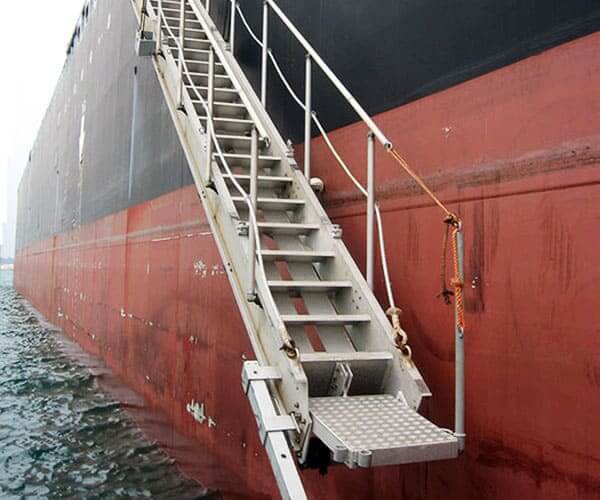
Gangways and boarding platforms: Lightweight construction reduces handling effort while maintaining structural integrity.
Design note: Thickness typically ranges from 3–8 mm depending on span, load, and stiffener spacing.

Stairs, Ramps, and Access Systems
Stair treads and ladders: Raised patterns reduce the risk of slips and falls in wet or exposed environments.
Ramps: Used for vehicle loading, cargo transfer, or passenger boarding, especially on ferries and workboats.
Escape routes: Non-slip surfaces are essential for compliance with marine safety regulations.
Design note: Directional patterns (e.g., 3-bar or 5-bar) are often preferred on ramps to improve grip along the travel direction.
Superstructures and Platforms
Wheelhouse roofs and access decks: Lightweight plates reduce top-weight and help maintain vessel stability.
Equipment platforms: Suitable for mounting winches, pumps, compressors, and navigation equipment.
Offshore and coastal platforms: Used for walkways and service platforms where corrosion resistance and safety are essential.
Engineering benefit: Reduced mass in elevated locations improves overall vessel stability and roll behavior.
Interior Floors and Utility Areas
Engine rooms: Resistant to oil, fuel, and cleaning chemicals; easy to clean and inspect.
Machinery spaces: Withstand vibration, foot traffic, and dropped tools better than many polymeric floor coverings.
Cargo holds and storage rooms: Provide a robust walking surface without requiring additional floor treatments.
Material choice: Alloys such as 5754 or 5052 are often selected for these applications due to their good formability and cost efficiency.
Small Craft, Yachts, and Workboats
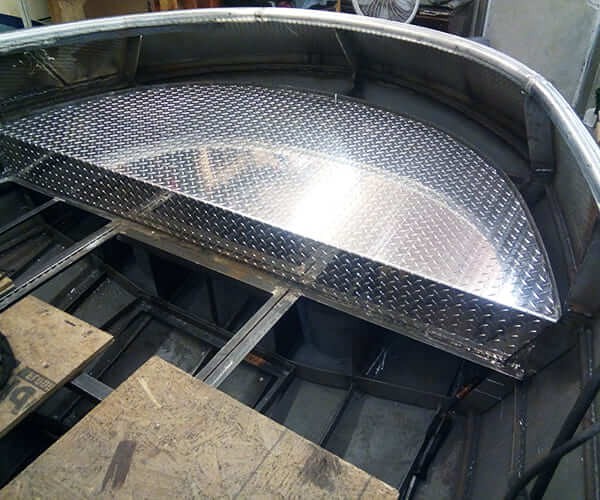
Cockpits and aft decks: Popular in fishing boats, patrol craft, and leisure boats.
Tender boats and RIB platforms: Lightweight plates improve handling and reduce launch/recovery effort.
Tooling and storage surfaces: Durable surfaces for heavy use in commercial fishing and service vessels.
Practical advantage: The combination of appearance and performance makes checkered plate suitable for both functional and visible areas.

Offshore and Industrial Marine Applications
Offshore wind and oil & gas installations: Walkways, stair treads, and service platforms exposed to aggressive marine atmospheres.
Floating docks and pontoons: Lightweight, corrosion-resistant surfaces for pedestrian traffic.
Shipyard and port infrastructure: Temporary platforms, maintenance walkways, and access ramps.
Performance focus: Resistance to corrosion and ease of replacement are key drivers in these environments.
7. Corrosion Behavior in Marine Environments
General corrosion resistance
Al–Mg marine alloys form a passive oxide film that provides very good resistance to seawater and marine atmospheres.
With good detailing (drainage, painting, insulation from dissimilar metals) they perform well for decades.
Galvanic and crevice corrosion risks
Galvanic coupling: aluminium is anodic to copper, brass and many stainless steels - isolate contact surfaces with gaskets, washers or coatings and avoid direct electrical contact.
Crevice corrosion: filling crevices with debris and salt accelerates local attack - design for drainage and access for cleaning.
Weld areas: HAZ softening does not necessarily reduce corrosion resistance, but poor cleaning of weld spatter or trapped flux can cause local corrosion - clean and coat as appropriate.
Regular inspection, sacrificial anodes where necessary, and prudent detailing minimize corrosion risk.
8. Standards and Specifications
Common standards and references for aluminium checkered plate include:
ASTM B632 - Specification for Aluminium-Magnesium Alloy Boat and Marine Plate, sheet and strips (checkered/tread variants) (often referenced for tempers and test requirements).
EN / ISO standards for aluminium alloy chemical and mechanical requirements (e.g., EN AW designations, EN 485 series for sheet/plate).
Class society approvals (DNV, ABS, Lloyd's) where plates are used in classed vessels or offshore structures - these may require certificates, traceability and specific tempers (e.g., 5083 H116).
9. Huawei Marine Grade Aluminium Checkered Plate Specification
Example specification
Product name: Marine Grade Aluminium Checkered Plate (example: "Huawei" series)
Alloy options: EN AW-5083, EN AW-5086, EN AW-5754, EN AW-5052 - buyer to specify.
Typical temper: H111 / H116 for 5083; H22 for 5754; H32/H34 for 5052 (as required for forming).
Thickness range: 0.8 mm – 12 mm (common stocked gauges: 1.2, 1.5, 2.0, 3.0, 4.5, 6.0 mm).
Pattern type: 3-bar / 5-bar / diamond (buyer to specify pattern and bar height).
Standard sizes: width 1000–2500 mm, cut lengths to order.
Surface finish: mill finish; optional anodize or primer + paint.
Mechanical minima (example): see table below (supplier must supply MTC).
5083 H111: Proof stress ≥125 MPa; UTS 275–350 MPa; elongation ≥10%.
5754 H22: Proof stress ~130–185 MPa; UTS 220–290 MPa; elongation ≥7–12%.
Documentation: Mill Test Certificate (EN 10204 / 3.1 or equivalent) required for each heat/lot.
Certifications (optional): DNV / ABS / Lloyd's / BV approval upon request.
Packaging: palletised with protective interleaving; corrosion inhibitors applied for export shipments.
10. Comparisons with Other Materials
Marine grade aluminium checkered plate is mainly compared with ship steel, fiberglass (FRP), and stainless steel in marine applications, with the following performance and economic differences:
| Performance Indicators | 5083 Aluminium Checkered Plate | Ship Steel Checkered Plate | FRP Plate | 316L Stainless Steel Plate |
| Density (g/cm³) | 2.68 | 7.85 | 1.8-2.0 | 7.98 |
| Tensile Strength (MPa) | 315-355 | 400-500 | 150-200 | 515-550 |
| Service Life (Years) | 15-25 | 8-12 (regular anti-corrosion required) | 10-15 (prone to aging) | 20-30 |
| Unit Price (RMB/ton) | 42,000 | 8,500 | 35,000 (by weight equivalent) | 180,000 |
| Annual Maintenance Cost (Ratio) | 1.0 (reference value) | 5.2 (including derusting and anti-corrosion) | 2.8 (including coating repair) | 1.2 (low maintenance) |
| Corrosion Resistance (ASTM B117 288h) | Excellent (corrosion rate ≤0.015g·m⁻²·h) | Poor (prone to pitting corrosion) | Good (salt spray resistant but aging-prone) | Excellent (corrosion resistant, no pitting) |
| Wet Coefficient of Friction (ASTM D1894) | ≥0.6 (pattern-enhanced) | ≈0.5 (pattern prone to rust failure) | ≈0.45 (surface prone to wear) | ≈0.55 (high difficulty in pattern processing) |
| Weldability | Excellent (compatible with MIG/TIG welding) | Good (conventional welding processes) | Fair (special bonding/welding processes required) | Excellent (but high welding cost) |
| Lightweight Coefficient (Strength/Density) | 117.5-132.5 | 51.0-63.7 | 75.0-111.1 | 64.5-68.9 |
11. Conclusion
Marine Grade Aluminium Checkered Plate is not simply a flooring product; it is a high-performance engineering system that provides a multi-faceted solution to the core challenges of the marine environment.
It masterfully combines the essential safety function of slip resistance with the structural benefits of high strength, the economic advantages of low maintenance, and the performance gains of lightweighting.
For any naval architect or shipbuilder aiming to create a safe, durable, and efficient vessel, the specification of a certified marine grade aluminium checkered plate is an unequivocal and intelligent investment in quality and longevity.
FAQs
Q1 - Which alloy should I choose for a ferry deck subject to heavy vehicle traffic?
A: Prefer 5083 or 5086 in appropriate temper (H116 etc.) with thickness sized to the vehicle loads and wheel footprints; these alloys have higher UTS and superior fatigue resistance.
Q2 - Can checkered plate be welded to flat plate of a different alloy?
A: Yes, but select compatible filler metal and account for galvanic potentials. Avoid coupling aluminium directly to copper/brass; use insulating gaskets or coatings.
Q3 - How do I specify anti-slip performance?
A: Specify pattern type, bar height and test data (e.g., coefficient of friction in wet/grease conditions) and confirm with supplier samples.
Q4 - What testing and documentation should I request?
A: Mill Test Certificate (EN 10204 3.1 or equivalent), chemical analysis, mechanical test results, and class society certificates if installed on classed vessels.
Q5 - How long does marine aluminium checkered plate typically last?
A: With correct alloy selection, detailing (drainage and isolation from dissimilar metals) and coatings where required, decades of service are typical; lifecycle depends on exposure severity and mechanical wear.
Send Inquiry
