Choosing a 1060 aluminum checker plate manufacturer is not only a matter of price. The supplier you pick decides whether the plates arrive flat, whether the pattern is sharp and consistent, and whether the mechanical properties match what was promised on paper.
1060 aluminum checker plate is widely used for anti-slip surfaces in transportation, construction, and industrial equipment. It combines high aluminum purity, excellent corrosion resistance, and easy forming with a raised surface pattern that improves grip.
For buyers, the main challenge is that checker plate looks simple but varies a lot in quality. Differences in raw material, rolling control, embossing accuracy, and inspection practice show up later as warped sheets, shallow patterns, or inconsistent temper.
This guide is written for importers, distributors, fabricators, and project contractors. It explains what 1060 checker plate is, how its composition and tempers affect performance, and what to check before placing an order.

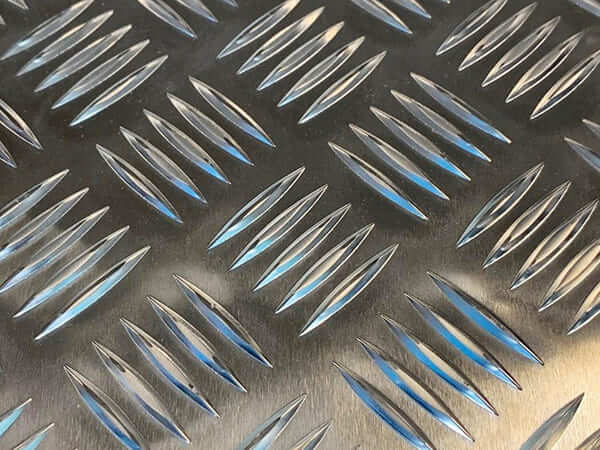
1060 aluminum checker plate is an embossed aluminum product manufactured from 1060 alloy. Its surface features regularly arranged raised patterns that create a textured appearance and can improve traction compared with a smooth aluminum sheet.
The designation 1060 identifies an aluminum alloy with a minimum aluminum content of 99.6%. Unlike heat-treatable aluminum alloys, 1060 develops its strength mainly through cold working rather than precipitation hardening. Manufacturers therefore select different tempers to achieve the required balance between strength and formability.
The main characteristics of 1060 aluminum checker plate include:
Manufacturers use patterned rollers or embossing equipment to create raised designs on aluminum surfaces. Different patterns offer different appearances and surface characteristics.
Five-bar pattern
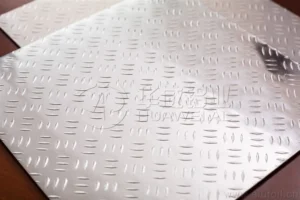
Five-bar checker plate features groups of raised ribs arranged in a repeated pattern. Its textured appearance makes it a common choice for flooring, vehicle steps, access platforms, and protective panels.
Three-bar pattern
Three-bar checker plate uses groups of three raised ribs. It offers a distinctive surface design and can suit decorative panels, light-duty flooring, and equipment applications.

Diamond pattern
Diamond checker plate features repeated diamond-shaped raised sections. It is widely used for decorative and protective applications, including vehicle interiors, workshop surfaces, and equipment covers.
Customized patterns
Some manufacturers can produce other raised designs according to available embossing rollers and customer requirements. Buyers should confirm pattern dimensions, height, spacing, and production feasibility before ordering.
1060 aluminum belongs to the commercially pure aluminum family. Its defining characteristic is a minimum aluminum content of 99.6%, while other elements remain within controlled limits.
The following table summarizes representative composition limits for 1060 aluminum sheet and plate under ASTM B209/B209M. Values are expressed as maximum weight percentages unless otherwise indicated.
| Element | Chemical Composition (wt.%) |
|---|---|
| Aluminum (Al) | ≥99.60 |
| Silicon (Si) | ≤0.25 |
| Iron (Fe) | ≤0.35 |
| Copper (Cu) | ≤0.05 |
| Manganese (Mn) | ≤0.03 |
| Magnesium (Mg) | ≤0.03 |
| Zinc (Zn) | ≤0.05 |
| Titanium (Ti) | ≤0.03 |
| Other elements, each | ≤0.03 |
| Other elements, total | ≤0.10 |
Note: These are representative ASTM B209 composition limits. The applicable standard edition and purchase specification should govern acceptance. The balance consists primarily of aluminum.
Because 1060 cannot be strengthened by heat treatment, its mechanical properties are controlled by cold working and annealing. The temper tells you how hard the plate is and how it will behave in use.
Temper designations explained
Typical mechanical properties (reference ranges)
| Temper | Tensile Strength (MPa) | Characteristics |
|---|---|---|
| O | about 60–95 | Softest, best for deep bending and forming |
| H12 | about 75–110 | Light strengthening, still very formable |
| H14 | about 85–120 | Balanced strength and workability |
| H16 | about 95–130 | Firmer, reduced bending ability |
| H18 | about 115 and above | Hardest, limited formability |
Values are indicative. Exact minimums and maximums depend on thickness and the applicable standard (for example ASTM B209 or EN 485-2). Always request actual test results.
Which temper is used for checker plate?
In practice, 1060 checker plate is most often supplied in H12, H14, H22, and H24. Embossing is a cold-forming step, so the base sheet is usually already partly strain-hardened. Fully annealed (O) plate is available, but it is softer and can dent more easily in service.
Choosing the right temper

The mechanical and physical properties of 1060 aluminum checker plate determine its suitability for flooring, protective panels, equipment covers, transportation components, and decorative applications. As a commercially pure aluminum alloy, 1060 offers excellent ductility, corrosion resistance, and thermal and electrical conductivity. However, its strength is lower than that of many alloyed aluminum grades, such as 3003 and 5052.
The mechanical properties of 1060 aluminum vary with temper and thickness. Annealed material generally offers the highest ductility, while cold-worked tempers provide greater tensile strength and hardness. The following table gives representative mechanical property ranges for common 1060 aluminum sheet tempers. These values are for material reference and preliminary selection; they should not be treated as guaranteed acceptance limits for every embossed plate.
| Temper | Tensile Strength (MPa) | Yield Strength (MPa) | Elongation (%) | General Characteristics |
|---|---|---|---|---|
| O | 60–95 | 15–35 | 20–35 | Excellent ductility |
| H12 | 70–110 | 35–75 | 8–20 | Moderate strength and good formability |
| H14 | 85–125 | 55–95 | 5–15 | Balanced strength and workability |
| H16 | 105–145 | 75–115 | 3–10 | Higher strength, reduced ductility |
| H18 | 120–160 | 90–130 | 2–8 | High hardness and limited formability |
| H22 | 70–110 | 35–75 | 8–20 | Partially annealed, relatively formable |
| H24 | 85–125 | 55–95 | 5–15 | Moderate strength and hardness |
Note: These are indicative ranges, not a substitute for standard-specific mechanical property tables. Actual values depend on thickness, product form, temper designation, and the applicable standard. For procurement, request the manufacturer’s MTC and verify the requirements against the agreed edition of ASTM B209/B209M or EN 485.
Tensile strength
Tensile strength measures the maximum stress a material can withstand before fracture during a tensile test. In 1060 aluminum, cold working generally increases tensile strength. This makes harder tempers more suitable for components requiring greater resistance to deformation.
Yield strength
Yield strength indicates the stress at which permanent deformation begins. It is particularly important when selecting checker plate for platforms, access panels, and equipment covers. Designers should use verified material values together with plate thickness, support spacing, and expected loads.
Elongation
Elongation indicates how much a material can stretch before fracture. 1060 aluminum generally has good elongation, particularly in the O temper. This property supports bending, forming, and embossing operations, although harder tempers offer less flexibility.
Hardness
Hardness describes resistance to localized indentation and surface deformation. It generally increases with strain hardening. However, hardness alone cannot determine whether a checker plate is suitable for a load-bearing application.
The physical properties of 1060 aluminum remain relatively consistent across its common tempers. These characteristics contribute to its use in electrical, thermal, architectural, and general fabrication applications.
| Property | Typical Value | Unit |
|---|---|---|
| Density | 2.70 | g/cm³ |
| Melting Range | Approximately 646–657 | °C |
| Thermal Conductivity | Approximately 230 | W/(m·K) |
| Electrical Conductivity | Approximately 61 | % IACS |
| Elastic Modulus | Approximately 69 | GPa |
| Poisson’s Ratio | Approximately 0.33 | – |
| Coefficient of Thermal Expansion | Approximately 23.6 | µm/(m·°C) |
Note: Values are representative of 1060 aluminum at or near room temperature. Exact values may vary with material condition, test method, and reference source.

Checker plate quality is built step by step. Weakness at any stage, from casting to packing, will show up in the finished product.
Production starts with primary aluminum ingot of at least 99.70% purity, which allows the melt to meet the 99.60% minimum of 1060. Ingots are melted in a furnace and held at a controlled temperature. The melt is analyzed with a spectrometer, and composition is adjusted before casting. Refining and degassing remove hydrogen and inclusions that would otherwise cause surface defects.
The refined metal is cast into slabs or continuous strip. Two routes are common:
The choice affects grain structure, surface quality, and cost. A manufacturer should be able to explain which route is used for your order.
Hot rolling reduces slab thickness at high temperature, breaking down the cast structure.
Cold rolling brings the material to its target thickness at room temperature, improving surface finish, flatness, and strength through strain hardening.
Rolling control directly affects thickness tolerance and flatness. Strict gauge control helps keep thickness consistent along the full length and width.
Annealing softens the metal and adjusts mechanical properties. Intermediate annealing restores workability between rolling passes. Final annealing or partial annealing sets the finished temper, such as O, H22, or H24. Temperature and time must be closely controlled. Poor annealing leads to uneven properties from coil to coil.
Embossing creates the raised pattern. The sheet passes between a patterned roll and a smooth or counter roll. Pressure presses the pattern into one surface. Pattern height depends on roll design, pressure, and material temper.
After embossing, plates are leveled to remove waviness and residual stress. They are then slit to width or cut to length. Tension leveling improves flatness. Precision cutting keeps edges clean and dimensions within tolerance. Edge burrs and camber (sideways bow) are checked.
To prevent scratches and moisture damage during transport:
Selecting the correct specifications is essential when purchasing 1060 aluminum checker plate. Different applications require different thicknesses, dimensions, patterns, tempers, and surface conditions. A suitable manufacturer should be able to clarify these requirements before production and provide products that match the buyer’s technical drawings or purchase specifications.
The following table summarizes the main parameters buyers should confirm when ordering 1060 aluminum checker plate.
| Parameter | Specification / Options |
|---|---|
| Alloy | 1060 |
| Aluminum Content | ≥99.6% |
| Temper | O, H12, H14, H16, H18, H22, H24, subject to product availability |
| Product Form | Checker plate / tread plate |
| Pattern | Five-bar, three-bar, diamond, customized patterns |
| Base Thickness | Customized according to requirements |
| Overall Thickness | Depends on base thickness and pattern height |
| Width | Customized |
| Length | Customized |
| Surface | Embossed mill finish or agreed surface treatment |
| Processing | Cutting, trimming, protective film, customized dimensions |
| Packaging | Export-standard wooden pallets or customized packaging |
The available thickness, width, and length depend on the manufacturer’s equipment, production route, and pattern specifications. Buyers should provide their target dimensions rather than assume that every size or temper is available as a standard product.
1060 aluminum checker plate combines low weight, good corrosion resistance, high ductility, and a patterned surface. These characteristics make it suitable for various decorative, protective, and light-duty industrial applications.
However, 1060 is a commercially pure aluminum alloy with relatively low mechanical strength. Its suitability for flooring and other load-bearing uses depends on plate thickness, temper, support spacing, installation design, and actual operating loads.

1060 aluminum checker plate can serve as a lightweight surface material for selected industrial walkways, maintenance areas, access covers, and workshop flooring. Its raised pattern creates a textured surface that may improve traction compared with smooth aluminum sheet under suitable conditions. Its low density also makes panels easier to transport, install, and remove.
Typical applications include:
The lightweight characteristics of 1060 aluminum checker plate make it useful for selected transportation components where reducing vehicle weight is beneficial. Common applications include:

1060 aluminum checker plate can also be used in architectural and decorative projects. Its metallic appearance and repeated raised pattern create a distinctive industrial-style finish. Typical applications include:
1060 aluminum checker plate is suitable for selected equipment covers and protective panels where lightweight construction and a textured surface are desirable. Typical applications include:

In commercial and public facilities, 1060 aluminum checker plate can serve as a decorative and protective surface material. Potential applications include:
1060 aluminum offers excellent thermal and electrical conductivity due to its high aluminum purity. This makes the alloy useful in certain heat-transfer and electrical applications. However, checker plate is not automatically the preferred product form for these purposes. Flat sheet, strip, or other specialized aluminum forms may provide better contact surfaces and dimensional characteristics.
Potential applications for 1060 aluminum products include:
Different aluminum alloys offer different combinations of strength, corrosion resistance, formability, weldability, and machinability. Comparing 1060 with 1100, 3003, 5052, and 6061 helps buyers select the right checker plate for their application.
| Comparison | 1060 Aluminum | 1100 Aluminum | 3003 Aluminum | 5052 Aluminum | 6061 Aluminum |
|---|---|---|---|---|---|
| Alloy Series | 1000 Series | 1000 Series | 3000 Series | 5000 Series | 6000 Series |
| Main Alloying Elements | Aluminum ≥99.6% | Aluminum ≥99.0% | Manganese (Mn) | Magnesium (Mg), Chromium (Cr) | Magnesium (Mg), Silicon (Si), Copper (Cu) |
| Typical Temper | O, H12, H14, H16, H18 | O, H12, H14, H18 | O, H14, H16, H18, H22, H24 | O, H32, H34, H36 | O, T4, T6 |
| Strength | Low | Low | Moderate | Medium to high | High, especially in T6 temper |
| Corrosion Resistance | Excellent in many general environments | Very good | Very good | Excellent, particularly in marine and humid environments | Good; may require additional surface protection in harsh environments |
| Formability | Excellent | Excellent | Very good | Good | Moderate; depends on temper and forming process |
| Weldability | Good | Good | Good | Very good | Good, although welding can reduce strength in the heat-affected zone |
| Machinability | Limited | Limited | Fair | Good | Very good |
| Electrical Conductivity | Excellent | Very good | Lower than 1060 and 1100 | Lower than 1000-series alloys | Moderate |
| Relative Weight | Lightweight | Lightweight | Lightweight | Lightweight | Lightweight |
| Main Advantages | High purity, excellent conductivity, lightweight, and outstanding formability | Good formability, corrosion resistance, and general-purpose performance | Better strength than 1060 and good workability | High strength, excellent corrosion resistance, and good weldability | High strength, good machinability, and heat-treatable properties |
| Common Checker Plate Patterns | Five-bar, three-bar, diamond, and customized patterns | Five-bar, diamond, and other decorative patterns | Five-bar, three-bar, diamond, and other industrial patterns | Five-bar, diamond, and customized patterns | Diamond, five-bar, and other industrial patterns, subject to product availability |
| Typical Applications | Decorative panels, equipment covers, light-duty flooring, and interior protection | General-purpose panels, decorative surfaces, and light-duty flooring | Industrial flooring, vehicle components, equipment platforms, and protective panels | Transportation flooring, marine-related structures, truck components, and industrial platforms | Machinery platforms, structural flooring, equipment components, and applications requiring higher strength |
| Best Selection Criteria | Applications prioritizing purity, conductivity, and formability over high strength | General-purpose applications requiring good forming performance | Applications requiring a balance of strength, corrosion resistance, and formability | Applications requiring higher strength and excellent corrosion resistance | Applications requiring high strength, machinability, and structural performance |
Consistent quality does not come from final inspection alone. It comes from control at every stage, backed by records that buyers can verify.
Aluminum ingot purity is checked against the 99.60% minimum required for 1060. Each batch is recorded to allow full traceability. Unsuitable material is rejected before melting.
| Stage | Control Points |
|---|---|
| Melting | Spectrometer analysis, temperature, degassing |
| Rolling | Thickness gauge, flatness, surface condition |
| Annealing | Temperature and time records, property consistency |
| Embossing | Pattern height, sharpness, roll condition |
| Leveling and cutting | Flatness, dimensions, burr and camber |
1. Chemical composition. Verified with optical emission spectrometry to confirm the alloy meets 1060 limits.
2. Mechanical properties. Tensile strength, yield strength, and elongation are tested on samples to confirm the temper.
3. Dimensional inspection. Thickness, width, length, diagonal difference, and flatness are measured against the standard or agreed tolerance.
4. Pattern inspection. Pattern height and uniformity are measured at several points across the sheet.
5. Surface inspection. Plates are checked for scratches, oil stains, roll marks, corrosion spots, and pattern defects.

Choosing a reliable supplier is essential for ensuring consistent product quality, accurate dimensions, and dependable delivery.
Henan Huawei Aluminum Co., Ltd., established in 2001, has over 20 years of experience in aluminum alloy production and sales, serving customers in 72 countries.
Key reasons to work with Huawei Aluminum include:
Whether you need 1060 aluminum checker plate for decorative panels, equipment covers, or light-duty flooring, Huawei Aluminum can help you evaluate suitable specifications and customized solutions. Contact Huawei Aluminum today to discuss your requirements and request a competitive quotation.

1060 aluminum checker plate combines the high purity, lightweight structure, good corrosion resistance, and excellent formability of 1060 aluminum with a raised surface pattern. These characteristics make it suitable for decorative panels, protective covers, light-duty flooring, vehicle interiors, and selected industrial applications.
However, 1060 is not a high-strength structural alloy. Buyers should evaluate its mechanical properties, temper, base-metal thickness, pattern design, and installation conditions before selecting it for load-bearing applications.
Compared with 1100, 3003, and 5052 aluminum checker plate, 1060 offers advantages in aluminum purity, conductivity, and formability, while 3003 and 5052 generally provide higher strength for more demanding applications.
When selecting a manufacturer, buyers should pay close attention to chemical composition, embossing consistency, dimensional accuracy, surface quality, inspection documentation, and export packaging.
As an experienced aluminum manufacturer, Henan Huawei Aluminum Co., Ltd. provides a range of aluminum products and customized processing services for international customers. By confirming the alloy, temper, dimensions, pattern, and quality requirements in advance, buyers can obtain aluminum products better suited to their production and application needs.
What is 1060 aluminum checker plate?
It is a patterned aluminum sheet made from 1060 alloy, containing at least 99.6% aluminum. It offers excellent corrosion resistance, formability, and lightweight performance.
What are the common patterns of 1060 aluminum checker plate?
Common patterns include five-bar, three-bar, and diamond designs. Customized patterns may also be available depending on production requirements.
What tempers are available?
Common tempers include O, H12, H14, H16, H18, H22, and H24. The appropriate temper depends on the required strength and forming performance.
What is the density of 1060 aluminum checker plate?
The typical density is approximately 2.70 g/cm³. Actual plate weight also depends on base thickness, pattern height, and dimensions.
What is the difference between base thickness and total thickness?
Base thickness measures the flat aluminum substrate, while total thickness includes the raised pattern. Buyers should confirm both when placing an order.
Is 1060 aluminum checker plate suitable for flooring?
Yes. It works well for light-duty flooring, walkways, and protective surfaces. For heavy loads or demanding industrial applications, consider stronger alloys such as 3003 or 5052.
How does 1060 compare with 3003 and 5052 aluminum checker plate?
1060 offers higher purity and excellent formability. 3003 provides a better balance of strength and workability, while 5052 offers higher strength and excellent corrosion resistance.
Can 1060 aluminum checker plate be cut, bent, and welded?
Yes. It generally offers good cutting, bending, and welding performance. However, the suitable process depends on temper, thickness, and fabrication requirements.
Which standards apply to 1060 aluminum checker plate?
Common reference standards include ASTM B209/B209M, EN 485, and the GB/T 3880 series. Confirm the applicable standard and product requirements with your supplier.
Can Huawei Aluminum provide customized 1060 aluminum checker plate?
Yes. Huawei Aluminum can discuss customized thickness, width, length, temper, pattern, surface finish, and packaging according to project requirements. Contact us for technical details and a quotation.